
Paradoxes have baffled people for thousands of years. They create situations where logic just seems to break down and contradictions refuse to be resolved.
These mind-bending puzzles might look like intellectual games at first. But actually, they serve a much deeper purpose in growing our reasoning abilities.
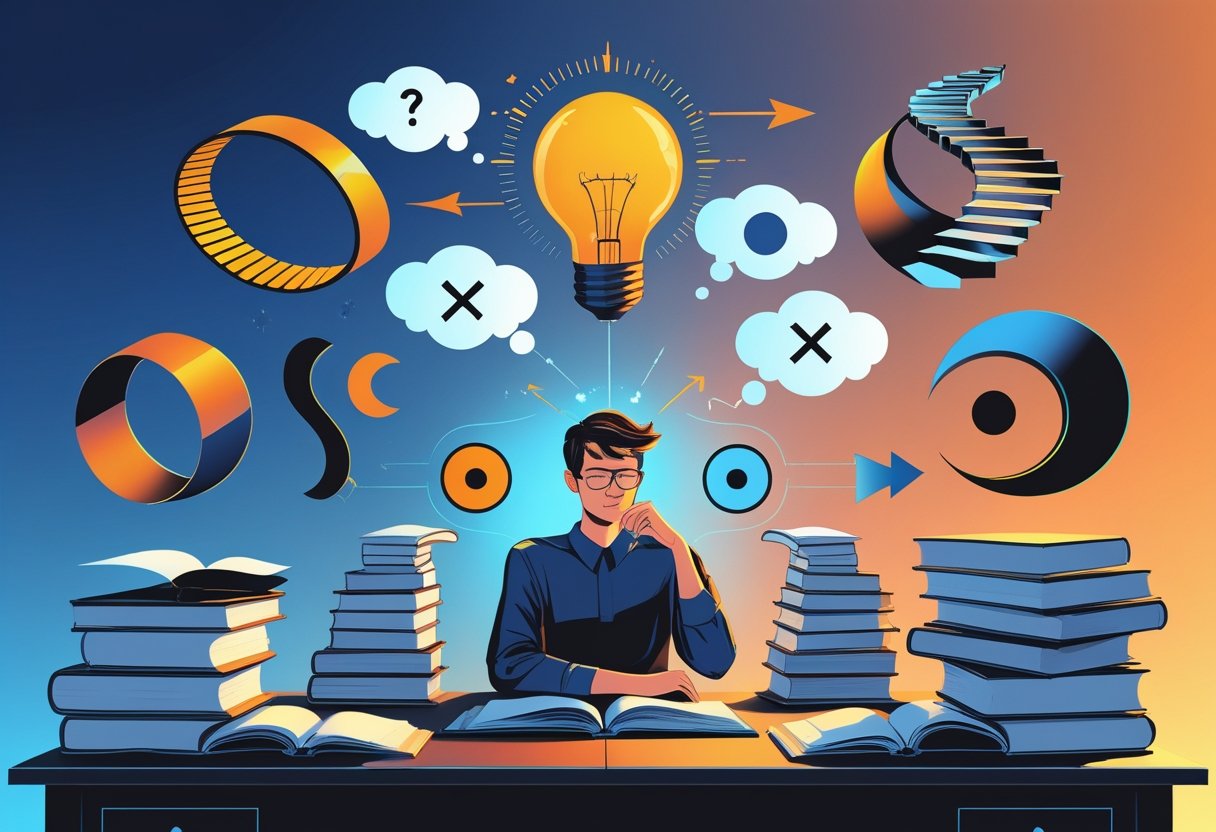
When you run into a paradox, your brain has to work overtime to make sense of conflicting information. This mental workout nudges us to question our assumptions and look at problems from more than one angle.
Paradoxes challenge our understanding of reasoning, leading to contradictions that refine critical thinking and help reveal flaws in logical systems.
The lessons from wrestling with contradictions go way beyond philosophy. These skills show up in real life whenever we face tough choices, tricky problems, or need to understand different viewpoints.
Key Takeaways
- Paradoxes strengthen critical thinking by forcing the mind to work through seemingly impossible contradictions
- These mental puzzles reveal weaknesses in logical reasoning and help refine problem-solving abilities
- The skills developed from studying paradoxes improve decision-making and creative thinking in daily life
Defining Paradoxes and Contradictions

Paradoxes throw out statements that feel contradictory, yet sometimes reveal deeper truths. Contradictions, on the other hand, just contain conflicting elements inside logical systems.
Both ideas play crucial roles in advancing philosophy and understanding how complex reasoning works.
What Is a Paradox?
A paradox pops up as a statement or situation that seems self-contradictory or impossible at first glance. But if you dig deeper, paradoxes deliver certain truths and higher-level meanings.
The classic “liar paradox” is a good example. Someone says “I am lying,” and suddenly you’re stuck in a loop. If they’re telling the truth, then they’re lying—if they’re lying, then it’s true.
Paradoxes are statements or situations that appear contradictory but often reveal deeper truths upon careful examination. They challenge our normal ways of thinking.
Key characteristics of paradoxes include:
- Self-referential nature
- Apparent logical impossibility
- Hidden insights when analyzed deeply
- Challenge to conventional reasoning
Contradictions Versus Paradoxes
Contradictions and paradoxes aren’t the same. Contradictions are conflicting elements within the same system, whereas paradoxes are conflicting elements that reveal previously unknown truths.
For example, someone says “the car is both red and not red at the same time.” That’s just a contradiction—no deeper insight there.
Paradoxes, though, point to gaps in our understanding. They expose flaws in logical systems, not just mistakes in reasoning.
| Contradictions | Paradoxes |
|---|---|
| Simple logical conflicts | Complex philosophical puzzles |
| Usually indicate errors | Reveal system limitations |
| Can be easily resolved | Often remain unsolvable |
| Provide no deeper insight | Offer profound understanding |
The Role of Paradoxes in Philosophy
Philosophers have used paradoxes as tools for deeper understanding for centuries. Paradoxes have led to important developments in logic and mathematics throughout history.
Russell’s paradox challenged early set theory. It asked whether the set of all sets that do not contain themselves contains itself, which forced mathematicians to rethink their foundations.
Socratic paradoxes dig into knowledge and wisdom. The famous “I know that I know nothing” exposes the limits of human understanding.
This ironic approach often exposes contradictions in reasoning.
Logical paradoxes challenge understanding of reasoning and have influenced development of set theory. They make philosophers examine basic assumptions about truth, knowledge, and reality.
These philosophical tools still shape how we think today. They help spot weak points in logic and encourage us to reason more carefully.
Logic and the Structure of Paradoxes
Paradoxes poke holes in logical systems by creating situations where valid reasoning leads to contradictions. These puzzles have shaped philosophy and math by forcing people to question basic ideas about truth and logic.
Paradoxes in Logic and Reasoning
Logical paradoxes challenge our understanding of reasoning by creating contradictions inside frameworks that seem sound. These contradictions pop up when accepted rules lead to opposite conclusions from the same starting point.
Russell’s paradox is a classic. It asks if the set of all sets that don’t contain themselves, contains itself. If it does, it shouldn’t. If it doesn’t, it should. Wild, right?
The study of contradictions is essential for understanding logical systems, especially with complicated ideas. Paradoxes show how logic can break down in certain cases.
The liar paradox is another favorite. “This statement is false”—if it’s true, it’s false; if it’s false, it’s true. You end up going in circles.
Types of Logical Paradoxes
Logical paradoxes split into a couple of main types. Paradoxes are classified into two main types: pseudo-paradoxes and genuine paradoxes.
Pseudo-paradoxes come from flawed reasoning or bad premises. Once you spot the error, the contradiction disappears.
Genuine paradoxes stick around even when the reasoning looks solid. These resist easy answers and sometimes force us to rethink the whole system.
Russell’s contradiction involves predicates, classes, and propositional functions. It came out of efforts to create a pure logical foundation for math.
Self-reference paradoxes are another big category. The liar paradox and its cousins create loops by referring back to themselves, causing contradictions.
How Paradoxes Challenge Logical Systems
Paradoxes make logicians take a hard look at the basics of reasoning. They have led to theorems and are not simply confined to sterile dialectic.
Several basic notions of logic have reached their present shape through attempts to solve paradoxes. This includes ideas like set, collection, and the core concepts of classical logic.
Russell’s paradox revealed that letting sets form without restrictions leads to contradictions. This pushed mathematicians to develop axiomatic set theory and type theory.
These paradoxes also introduced the predicative/impredicative distinction. That concept became important for both theory and proof methods.
Major impacts include:
- Axiomatizations of set theory
- Development of type theory
- Foundations of semantics
- Theory of formal systems
These challenges drove philosophy and math to build stronger foundations. Paradoxes still shape how we think about logic and reasoning today.
Famous Paradoxes and Their Implications
These famous paradoxes show how contradictions can reveal deep truths about logic, time, language, and reality. Each paradox makes us question things we normally take for granted.
Zeno’s Paradox and Achilles and the Tortoise
Zeno’s paradox sets up a race between Achilles and a tortoise. The tortoise gets a head start.
When Achilles gets to the tortoise’s starting point, the tortoise has moved forward. When Achilles gets to that new spot, the tortoise moves again.
This keeps going, over and over. Zeno claimed Achilles would never catch the tortoise because there’s always another small distance to cover.
Key Elements of the Paradox:
- Infinite division of space and time
- Mathematical limits vs. physical reality
- The gap between theory and observation
The paradox highlighted issues with early ideas about infinity. It pushed mathematicians to develop better ways to handle infinite series.
Modern calculus cracks the puzzle. The infinite steps add up to a finite distance, so Achilles really does catch the tortoise.
This paradox reminds us that our instincts about infinity can be way off. It forced math to get clearer about limits and sums.
The Sorites Paradox
The Sorites paradox asks: at what point does a heap of sand stop being a heap? Take away one grain at a time from a pile.
One grain can’t be the difference between a heap and not-a-heap. But somewhere along the way, the heap disappears.
The Logic Problem:
- 10,000 grains = heap
- Removing one grain cannot change heap to non-heap
- So 9,999 grains = heap
- This goes all the way down to 1 grain
Now we’ve got a contradiction. We know one grain isn’t a heap, but the logic says it is.
This paradox shows that some ideas have blurry edges. Words like “heap,” “tall,” or “bald” don’t have clear cutoffs.
This comes up in real life all the time. Court cases, medical calls, policies—they often deal with fuzzy boundaries.
The Sorites paradox nudges us to avoid black-and-white thinking. A lot of important ideas exist on a spectrum, not in neat boxes.
The Bootstrap Paradox
The bootstrap paradox throws a wrench into how we think about time travel. Here, information or objects exist with no clear beginning at all.
Picture this: a time traveler goes back and teaches Shakespeare how to write Hamlet. Shakespeare pens the play, it survives to modern times, and then the time traveler learns Hamlet and heads back to teach it again.
The Circular Problem:
- Who actually wrote Hamlet?
- The information just loops—no real starting point
- Effect turns into its own cause
This kind of paradox pops up in tons of time travel stories. Someone goes back and sparks the very events that led them to time travel in the first place.
The paradox really messes with our sense of cause and effect. It suggests circular causation might work, even if it feels off.
Scientists still argue about whether loops like this could happen in actual physics. Some theories, like closed timelike curves, leave the door open for these situations.
The bootstrap paradox makes you wonder about creativity and originality. Are new ideas ever truly new, or are they just caught in some strange loop?
The Liar Paradox
The liar paradox comes from the sentence “This sentence is false.” It creates a situation that just can’t be solved.
If the sentence is true, then it’s false, since that’s what it says. If it’s false, then it’s true, because it describes itself accurately.
Analysis of the Contradiction:
| If the statement is… | Then it must be… | Because… |
|---|---|---|
| True | False | It says it’s false |
| False | True | It correctly describes itself |
This puzzle has been haunting thinkers for over 2,000 years. Epimenides, an ancient Greek philosopher, brought up a version of it long ago.
The liar paradox exposes problems with self-reference in language and logic. When statements talk about themselves, you can end up with contradictions that just won’t quit.
Modern computer science runs into similar headaches. Self-referential code can spiral into infinite loops or crash with logical errors.
The liar paradox reminds us that language has limits. Not every sentence that sounds normal actually makes sense or has a clear truth value.
Paradoxes as Catalysts for Critical Thinking
Paradoxes spark critical thinking by forcing us to juggle different perspectives and question what we believe. They create a kind of mental friction that pushes us to dig deeper into our own thinking.
Stimulating Cognitive Flexibility
Paradoxes make people hold two clashing ideas in mind at once. That mental balancing act actually strengthens the brain’s ability to flip between concepts and viewpoints.
When you hit the liar paradox—”This statement is false”—your brain works overtime. It’s a logical loop that can’t be untangled by simple reasoning.
Paradoxes push us to consider multiple angles at once. Take Zeno’s paradox about Achilles and the tortoise: suddenly, you have to rethink motion, time, and distance from scratch.
This flexibility comes in handy for other problems. People who wrestle with paradoxes often get better at:
- Perspective-taking: Seeing problems from more than one side
- Mental adaptation: Shifting gears when the old way doesn’t work
- Creative solutions: Finding new ways through tough challenges
The Ship of Theseus paradox is a perfect example. You have to ask if identity depends on physical parts or on the whole structure.
Questioning Assumptions
Paradoxes poke holes in the logical assumptions we usually take for granted. They dig up hidden beliefs and make us examine basic concepts.
The barber paradox asks, “Who shaves the barber who shaves only those who don’t shave themselves?” It’s a simple question, but it exposes big problems with basic logic.
When people run into this paradox, they start questioning assumptions about:
| Assumption Type | What Gets Questioned |
|---|---|
| Logical categories | Can something belong to two clashing groups? |
| Self-reference | What happens when statements talk about themselves? |
| Complete systems | Are logical systems always consistent? |
Russell’s paradox forced mathematicians to rebuild set theory from scratch. Sometimes, questioning assumptions leads to real breakthroughs.
Paradoxes reveal flaws in logic and push us to rethink our reasoning. They show that common sense isn’t always right.
Encouraging Metacognition
Paradoxes get us thinking about our own thinking. They make us notice how we handle contradictions and tricky problems.
When you wrestle with a paradox, you start noticing your own mental habits. You realize when you’re stuck, frustrated, or suddenly have an “aha” moment.
This kind of self-awareness sharpens critical thinking by:
- Strategy monitoring: Spotting when your approach isn’t working
- Error detection: Catching mistakes before you decide on an answer
- Approach adjustment: Switching tactics when you hit a wall
Grappling with paradoxes builds mental stamina. People learn to stick with confusion and not just throw in the towel.
These metacognitive skills spill over into daily life. Students figure out when they need to study differently. Professionals notice when their go-to methods aren’t enough.
Paradoxes and Creative Thinking
Creative minds often light up when they hit contradictions. Paradoxes can spark creative leaps by making people fully embrace clashing demands and invent new ways to combine opposing ideas.
Fostering Innovation through Contradictions
Innovation asks people to hold two opposing ideas at once. That tension creates space for fresh thinking.
Companies that lean into contradictions often come up with more creative fixes. Teams juggle structure and flexibility. They plan but stay ready to pivot.
Creative performance jumps when people with different thinking styles face paradoxes. Rigid thinkers might freeze up, but flexible folks see possibilities.
Key Innovation Paradoxes:
- Speed vs. Quality: Moving quickly but not letting standards slip
- Control vs. Freedom: Giving direction but also room to experiment
- Tradition vs. Change: Respecting history while chasing the new
The paradox mindset treats tension as a chance to grow and learn. That attitude helps teams manage competing demands without getting stuck.
The Link Between Paradoxes and Creativity
Creative thinking thrives on contradictions. Creative minds use paradoxes as fuel instead of trying to solve them. The push and pull between ideas leads to new answers.
A paradox throws a wrench in straightforward thinking. Wrestling with that confusion fires up both critical and creative parts of the mind. People have to invent new ways to handle the clash.
Creative work often follows paradoxical patterns:
| Creative Action | Paradox |
|---|---|
| Brainstorming | Organized but still spontaneous |
| Problem-solving | Questioning everything, yet working within limits |
| Idea development | Thinking big and sweating the small stuff |
Creative people seem to welcome contradictions. They mix logic with intuition, question assumptions, and build on what they already know.
Using Paradoxes to Inspire New Perspectives
Paradoxes push us to break out of routine thinking. When faced with a contradiction, the mind scrambles for a new angle.
Teachers love using paradoxes to get students thinking deeper. They use conceptual polarities, personal contradictions, and paradoxical scenarios to help learners grapple with complexity.
Practical Applications:
- Design thinking: Creating things that are simple but still rich
- Leadership development: Balancing confidence with humility
- Problem-solving workshops: Pushing wild ideas, but within some boundaries
The trick is getting comfortable with the discomfort. People who can sit with contradictions often spot solutions others overlook. They connect dots nobody else sees.
Creative teams get a boost when they deliberately throw paradoxes into the mix. It stretches their thinking and uncovers new possibilities.
Applying Lessons from Paradoxes in Everyday Reasoning
Learning to live with contradictions changes how we tackle tough problems and make decisions. Wrestling with paradoxes builds better thinkers who can handle uncertainty and invent creative fixes.
Problem-Solving Strategies
Traditional problem-solving usually pushes us to pick one side. Paradoxical thinking lets us explore both sides and find answers that work with the tension.
When you’re stuck, try these steps:
Step 1: Spot the contradictions
Find the parts of the problem that seem to clash. Write them out—don’t gloss over them.
Step 2: Hold both sides
Resist the urge to pick a favorite. Try to understand why each side matters.
Step 3: Hunt for connections
Ask yourself how the two sides might actually support each other, or if they depend on each other in some weird way.
This method works wonders in workplace conflicts. A manager might realize the team needs structure and freedom. Instead of choosing, they set clear goals but let folks decide how to get there.
Enhancing Decision-Making
Most decisions come down to weighing pros and cons. Paradoxes shake up that routine and get decision-makers to ask different questions.
Smart thinkers start asking things like:
| Traditional Question | Paradoxical Question |
|---|---|
| Should I be careful or bold? | How can I be careful and bold? |
| Do I need speed or quality? | Where do speed and quality help each other? |
| Should I lead or listen? | When does leading require listening? |
These questions reveal options that weren’t obvious before. A business owner might find ways to cut costs and invest in growth at the same time.
The real move is shifting from either-or to both-and thinking. That shift opens up choices most people would miss.
Practical Techniques for Embracing Contradictions
Daily life throws all sorts of contradictions at us. Learning through paradox actually sharpens your thinking over time.
The Contradiction Journal
Jot down contradictions you spot each day. Notice how you deal with them and what you pick up along the way.
The Flip Exercise
If you feel certain about something, spend five minutes arguing the opposite. It’s a surprisingly good way to stretch your mind.
The Both-And Challenge
Swap “but” for “and” when you think things through. Instead of “I want to save money but I need new clothes,” say, “I want to save money and I need new clothes.”
Question Your Certainty
When something seems obvious, pause and ask yourself why the opposite might be true. It’ll slow you down just enough to avoid jumping to conclusions.
Embrace Discomfort
Notice when contradictions make you uneasy. Use that discomfort as a nudge to dig deeper instead of rushing to pick a side.
Frequently Asked Questions
Paradoxes mess with the mind by forcing us to think beyond our usual patterns. They poke holes in our reasoning and push us to find new ways to solve problems.
How do philosophical paradoxes challenge our understanding of logic?
Philosophical paradoxes break the rules that logic depends on. You end up with two true statements that somehow lead to an impossible result.
The Liar Paradox is a classic example. When someone says “This statement is false,” it creates a loop with no way out. If it’s true, it must be false—if it’s false, then it must be true. Maddening, right?
Logical paradoxes reveal flaws in logical systems and force experts to rethink their theories. These breakdowns have actually changed how people approach math, philosophy, and reasoning.
Russell’s Paradox blew up early set theory by asking about sets that contain themselves. Mathematicians had to invent new rules for sets just to move forward.
Can a contradiction exist within sound logical reasoning?
Real contradictions just can’t exist in sound logical reasoning. If a logical system allows contradictions, it falls apart.
Sound reasoning sticks to strict rules. Two opposite statements can’t both be true at the same time—this is the law of non-contradiction.
But when you spot a contradiction, it usually means something deeper is off. Maybe your assumptions are wrong, or the reasoning has slipped somewhere.
Some paradoxes look like contradictions, but they’re really pointing to missing info. Paradox questions often involve two facts that seem to conflict until you dig up more details.
What are practical approaches to resolve logical paradoxes?
Start by questioning every basic assumption in the paradox. A lot of paradoxes vanish when you look at what you’re taking for granted.
Being skeptical and questioning assumptions helps you spot where the problem actually starts. This critical approach often uncovers hidden flaws in the setup.
Look for missing information. Sometimes, the contradiction exists simply because someone left out an important fact.
Try breaking the paradox into smaller pieces. It’s easier to figure out where the logic breaks down if you examine each part on its own.
If you change the framework or context, new solutions sometimes pop up. What seems impossible in one system can make perfect sense in another.
In what ways do paradoxes reveal the limits of human cognition?
Paradoxes highlight the limits built into human thinking. Our minds naturally hunt for simple patterns and clear answers.
The mental effort required to resolve paradoxes activates higher-order thinking, but also exposes where that thinking just breaks down. We struggle with ideas that don’t fit into neat categories.
Our brains crave consistency and get thrown off by real contradictions. This urge for simple explanations sometimes blocks more creative solutions.
Language itself adds to the problem. Words just can’t always capture the weird space between opposites.
Plus, our memory and attention have limits. It’s tough to juggle all parts of a complicated paradox at once, so we rarely see the whole thing clearly.
How do paradoxes impact decision-making processes in critical situations?
Paradoxes can freeze decision-making when conflicting information seems equally solid. You end up stuck because your usual decision rules don’t work.
In emergencies, paradoxes force people to act with incomplete info. Sometimes you just have to pick a path, even if logic doesn’t give you a clear answer.
Some paradoxes show that pure logic isn’t enough for certain decisions. At that point, personal judgment and values have to step in.
Paradoxes challenge conventional wisdom and push decision-makers to consider options they’d normally skip. This can lead to creative solutions, if you’re open to it.
When time’s tight, paradoxes get even trickier. People sometimes make bad calls just because they can’t untangle the contradiction quickly enough.
What role do paradoxes play in the development of critical thinking skills?
Understanding paradoxes improves critical thinking and problem-solving skills by forcing the mind to work in new ways.
They teach us to question what seems obvious. I mean, how often do we just accept things at face value?
Pondering paradoxes pushes reasoning beyond its normal limits. It’s a workout for your brain, really.
This practice makes people better at handling complex problems. You start to notice how tangled real-life situations can get.
Paradoxes teach the value of looking at problems from more than one angle. The first explanation isn’t always the right one—sometimes it barely scratches the surface.
Working with paradoxes builds tolerance for uncertainty and confusion. That’s a skill I wish more people had, honestly.
They help us hold conflicting ideas in mind without immediately rejecting one side. That’s pretty much essential for deep analysis and creative thinking, isn’t it?