Confirmation Bias: Why You Only See What You Expect to See
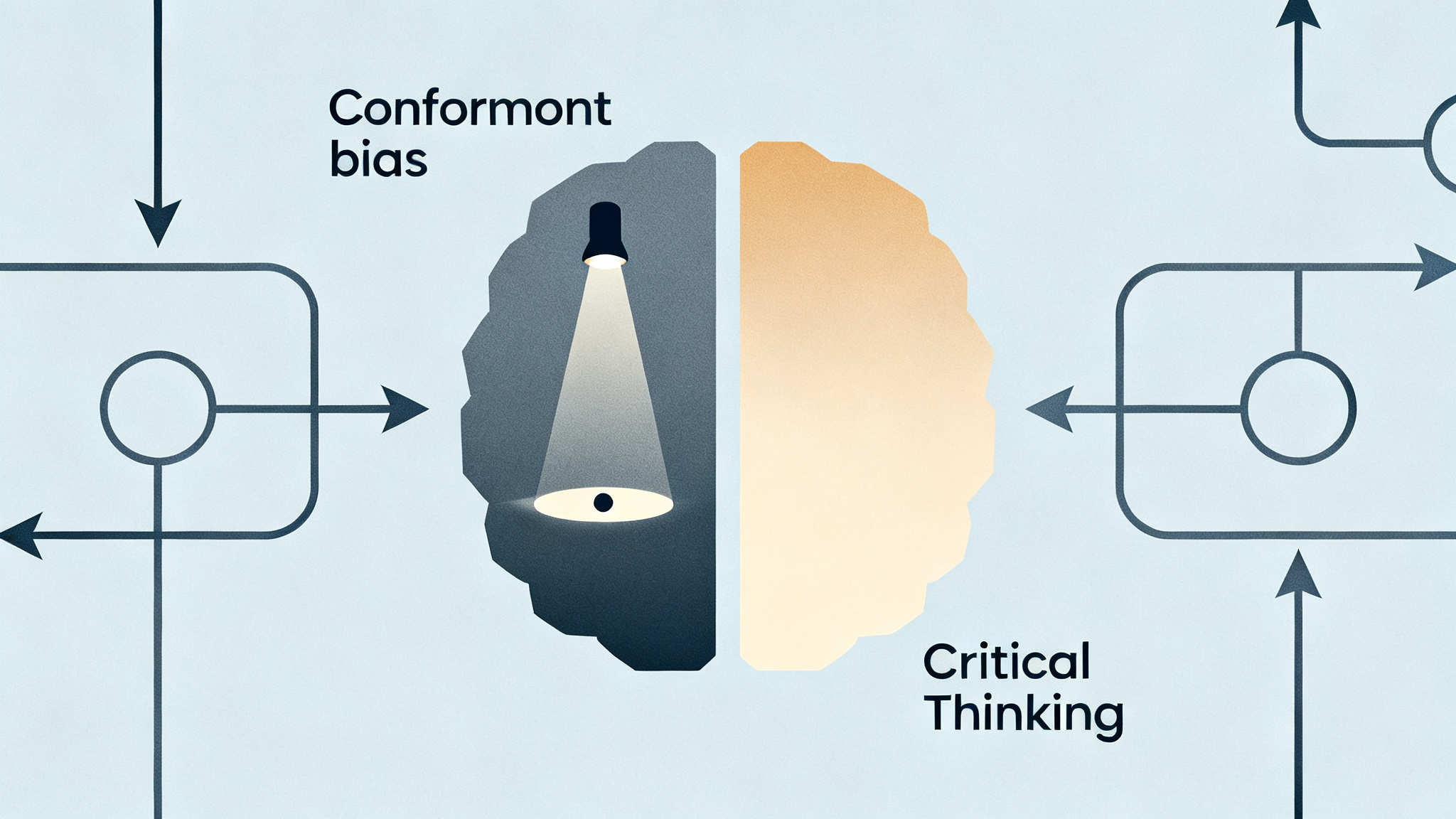
Every day, your brain is quietly filtering reality. Information that fits what you already believe gets noticed, remembered, and repeated. Information that contradicts your beliefs gets ignored, dismissed, or forgotten. This filtering process has a name: confirmation bias. It is one of the most well-documented and consequential errors in human reasoning, and the troubling part is that it operates largely below conscious awareness. Understanding it is not just an academic exercise — it directly affects the quality of every decision you make.
What Confirmation Bias Actually Is
Confirmation bias is the tendency to search for, interpret, favor, and recall information in a way that confirms or supports your pre-existing beliefs or hypotheses. The term was popularized by British psychologist Peter Wason following his experiments in the 1960s, though the underlying phenomenon had been observed long before that.
It operates on three distinct levels:
- Selective search: You look for evidence that supports what you already think, rather than evidence that could disprove it.
- Selective interpretation: Ambiguous evidence gets read as confirmation. The same data point that supports your view also contradicts it — you just do not notice the contradiction.
- Selective recall: Your memory preferentially stores and retrieves information consistent with your existing beliefs.
It is important to distinguish confirmation bias from simply being wrong. Everyone holds incorrect beliefs at times. Confirmation bias is the mechanism that keeps you wrong — the system that prevents you from updating when you should.
Why It Happens: The Research
Wason’s original work, now known as the Wason Selection Task, demonstrated that people overwhelmingly prefer to test hypotheses by looking for confirming evidence rather than disconfirming evidence. When given a simple logical rule and asked to test it, most participants chose cards that could only confirm the rule — ignoring cards that could falsify it. Falsification is logically more powerful, but psychologically more uncomfortable.
Later research by Stanford psychologists Charles Lord, Lee Ross, and Mark Lepper showed that people presented with mixed evidence on a charged topic — in their 1979 study, capital punishment — rated evidence that supported their prior view as higher quality and more convincing than equally rigorous evidence pointing the other way. Both sides became more entrenched after seeing the same data. This phenomenon is called attitude polarization, and it illustrates how confirmation bias does not just preserve existing beliefs — it can actively intensify them.
From a cognitive standpoint, the brain is an efficiency-seeking machine. Evaluating every piece of incoming information from scratch would be metabolically expensive and slow. Using prior beliefs as shortcuts — what psychologists call heuristics — speeds up processing. Confirmation bias is partly a byproduct of this efficiency drive. The problem is that efficiency and accuracy are not the same thing.
There is also a social and emotional component. Beliefs, particularly on identity-linked topics like politics, religion, or personal competence, are tied to our sense of self. Challenging a belief can feel like a personal attack. The brain’s threat-detection systems respond accordingly, triggering defensiveness rather than open inquiry.
Real-World Examples
Consider a hiring manager who decides early in an interview that a candidate is a strong fit. From that moment, questions subtly shift. Ambiguous answers get generous interpretations. Strong answers get noted. Weak answers get explained away. By the end, the manager feels they have confirmed their initial impression — when in reality, they spent the interview building a case for a conclusion they had already reached.
A more consequential historical example: the lead-up to the 2003 invasion of Iraq. Intelligence agencies and policymakers who believed Iraq possessed weapons of mass destruction consistently sought and emphasized evidence that supported that conclusion. Reports that cast doubt were downweighted or dismissed. The result was a catastrophic intelligence failure, driven in significant part by institutionalized confirmation bias — sometimes called groupthink when it occurs at an organizational level.
At the individual level, confirmation bias shapes how people consume news. If you believe that crime is rising, you will notice every news story about a violent incident. You will not notice — or will not register as relevant — statistics showing that crime rates have declined. Your subjective impression diverges from reality, and it feels accurate because the evidence you have collected genuinely does support it. You collected it.
How to Counter It
Confirmation bias cannot be eliminated. Research does not support the idea that simply being aware of a cognitive bias is enough to neutralize it. However, awareness combined with deliberate structural habits can meaningfully reduce its impact.
Actively Seek Disconfirming Evidence
Before concluding that you are right, ask: what would have to be true for me to be wrong? Then go looking for that. This is called disconfirmatory reasoning, and it mirrors how good science works. A hypothesis that cannot be tested against evidence that could disprove it is not really a hypothesis — it is just a belief dressed up as one.
Use the Steel Man, Not the Straw Man
A straw man argument is a weakened version of an opposing view, easy to knock down. A steel man argument is the strongest possible version of that view. When examining a position you disagree with, construct the best version of it. If you cannot accurately describe why a reasonable person holds that position, you probably do not understand it well enough to dismiss it.
Separate Data Collection from Interpretation
When gathering information on an important decision, deliberately separate the phase where you collect evidence from the phase where you draw conclusions. Once you start interpreting, the confirmation machine switches on. Getting more data first, before committing to a reading, reduces the effect.
Diversify Your Information Sources
If every source you read reaches the same conclusions you already hold, that is a structural problem. This does not mean treating all sources as equally credible — source quality matters enormously. It means deliberately including high-quality sources that challenge your priors, rather than only those that reinforce them.
Track Your Predictions
One of the most effective long-term tools against confirmation bias is keeping a record of your predictions and checking them against outcomes. This practice, associated with the work of forecasting researcher Philip Tetlock, forces a reckoning with accuracy rather than letting memory quietly revise history in your favor.
Key Takeaway: What to Do
Confirmation bias is not a character flaw. It is a structural feature of how human cognition works under pressure and uncertainty. But acknowledging that does not mean accepting it passively.
- Name the process. When you notice yourself feeling certain, ask whether you have actually tested your belief or just accumulated supporting examples.
- Ask what would change your mind. If there is no possible evidence that could shift your position, you are not reasoning — you are rationalizing.
- Build in opposition. Assign someone the explicit role of critic before a major decision. This is called a pre-mortem — imagining the decision has already failed and working backward to explain why.
- Review your track record. Confidence that is not calibrated against outcomes is just noise. Track your predictions and update accordingly.
The goal is not certainty — it is accuracy. Those are not the same thing, and confirmation bias thrives in the gap between them.
Want to sharpen your thinking even further? Check out The Thinker’s Toolkit – our monthly membership of practical frameworks, worksheets, and a practice app to help you reason better, spot biases, and make smarter decisions.